The rain in New York City doesn’t just fall; it punishes. It’s a relentless, icy needle-prick that turns the grease of the gutters into a slick, shimmering rainbow of urban decay. On this particular Tuesday night, the humidity was thick enough to choke a man, and the steam rising from the manhole covers looked like the breath of the city itself—heavy, tired, and smelling of old iron.
I’m Officer Marcus Davis. Twelve years with the NYPD, and I thought I’d seen every flavor of misery the five boroughs had to offer. I’ve chased ghosts through the projects of Bed-Stuy and wrestled demons in the subways of Manhattan. But nothing—no training, no veteran’s grit—could have prepared me for the silence I found tucked behind a dumpster on 4th Avenue.
The call had come in as a “10-13″—officer needs assistance—but it was a garbled mess of a report. Some rookie had spotted movement in an alleyway known for nothing but drug deals and discarded dreams. When I rolled up, the red and blue strobes of my cruiser were dancing off the wet brick walls, creating a flickering disco of authority in a place that usually shunned the light.
I stepped out of the RMP (Radio Motor Patrol), the heavy soles of my boots splashing into a puddle of oily water. My tactical vest felt like a lead weight on my chest, not because of the gear, but because of the vibe of this place. It was too quiet. The city’s heartbeat—the distant rumble of the G-train, the wail of sirens three blocks over—seemed to muffle into a dull throb.
“Dispatch, Davis,” I muttered into my shoulder mic, my voice raspy from a double shift and too much burnt precinct coffee. “I’m entering the alley. 10-13 confirmed. Sit tight.”
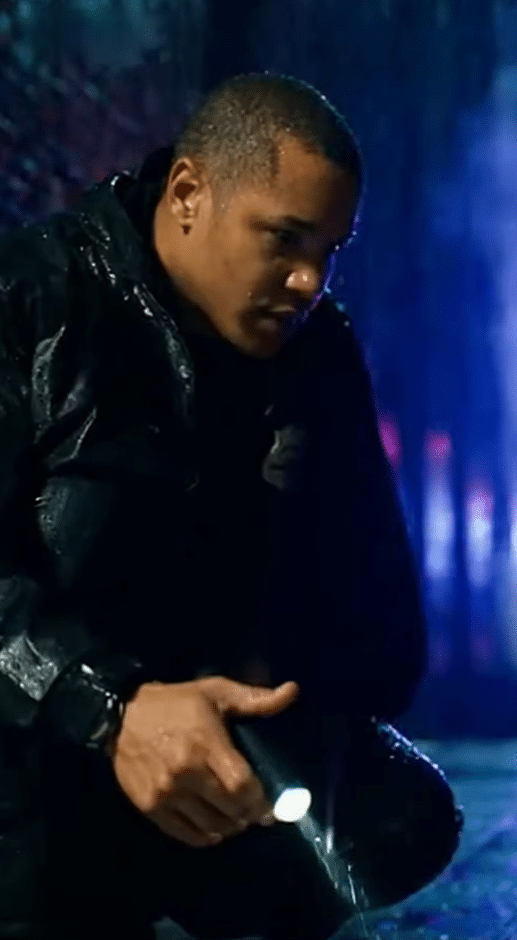
I clicked on my Maglite. The beam was a surgical blade, cutting through the thick New York fog. I moved past a rusted-out dumpster that smelled of rotting cabbage and damp cardboard. The steam from a nearby vent swirled around my legs, making it feel like I was walking through a dream.
Then, the light hit something that didn’t belong.
Behind a stack of soggy cardboard boxes, tucked into the smallest crevice of the brickwork, sat a ghost.
Except this ghost was wearing an oversized grey hoodie and dirty sneakers.
It was a boy. Maybe six years old. His skin was the color of a winter moon, pale and translucent, and his eyes were wide, reflecting my flashlight like a deer caught in the high beams. He was shivering so violently I could hear his teeth chattering over the sound of the rain hitting the trash cans.
And he wasn’t alone.
Clutched to his chest, held with a grip that suggested he’d die before letting go, was a bundle wrapped in a coarse, stained yellow towel. A tiny, knitted beanie poked out from the top.
“Hey, hey buddy…” I said. I felt my heart do a slow, heavy roll in my chest. This wasn’t a criminal. This wasn’t a threat. This was a tragedy.
I did the only thing I knew how to do to keep him from bolting. I dropped to one knee. The wet asphalt soaked through my uniform pants immediately, the cold biting at my skin, but I didn’t care. I lowered my flashlight, pointing it at the ground so the secondary glow would illuminate me without blinding him. I wanted him to see the badge, but more importantly, I wanted him to see the man behind it.
I raised my left hand, palm open, empty. A gesture of peace in a city at war with itself.
“You’re safe,” I said, pitching my voice low. I used that “dad voice”—the one I used back home when my own girls were scared of a thunderstorm. “Just tell me, you hurt? You okay, son?”
The boy didn’t move for a long second. He flinched when a stray cat knocked over a tin can further down the alley, pulling the bundle even tighter. His knuckles were white. He looked at my face, searching for something—maybe a sign of the monsters he’d been hiding from. Then, his eyes traveled to my silver shield.
The rain was pouring off the brim of my cap now, blurring my vision, but I didn’t blink. I couldn’t.
“It’s just…” the boy started. His voice was a thin, breaking reed, barely audible over the wind whistling through the narrow gap between the buildings. “It’s just us now.”
A tear tracked through the grime on his cheek, leaving a clean trail of salt and sorrow. He looked down at the yellow towel. As if on cue, a tiny, muffled coo came from the bundle. A newborn. Maybe a week old, if that.
The weight of the realization hit me like a physical blow. Somewhere in this concrete jungle, a mother was gone, or a home had vanished, and this six-year-old had become the sole guardian of a life even more fragile than his own. He wasn’t just a kid; he was a sentry.
“I gotcha,” I whispered, and for the first time in a decade, my voice caught.
I didn’t wait for backup. I didn’t wait for the paramedics. I stood up and unzipped my heavy NYPD rain jacket. It was warm, lined with fleece, and carried the scent of the precinct and laundry detergent. I draped it over him, wrapping the heavy fabric around both the boy and the baby. It was so big on him it looked like a tent, but the shivering slowed almost instantly.
“Come on,” I said, my voice regaining its authoritative edge, but softened by a deep, protective instinct. “Let’s get you warm. I’ve got a car with the heater on blast and some crackers in the glove box. How’s that sound?”
I guided them toward the mouth of the alley. I stayed on his windward side, using my own body to block the freezing gusts of the New York wind. Every few steps, I glanced back at the darkness of the alley. I felt a sudden, irrational anger at the shadows—at a world that could let a child end up behind a dumpster with a newborn.
As we reached the RMP, the blue and red lights washed over us. Usually, those lights meant trouble. Tonight, they were a lighthouse.
I opened the heavy rear door of the cruiser. The interior light flickered on, showing the scarred plastic of the prisoner transport seat—a seat usually reserved for the worst of society. Tonight, it would be a sanctuary.
I helped the boy slide in. He held that baby like it was made of thin glass. I looked him in the eye one last time before closing the door.
“You did good, kid,” I said. “You did real good. I’ll take it from here.”
I slammed the door shut. The heavy thud echoed off the brick walls, a final punctuation mark on the nightmare. I stood there for a second, my chest heaving, the red taillights of my car illuminating the rain as it turned into a crimson mist.
I looked at the camera of my own dashcam, my face hardened, my jaw set. I was an officer of the law, yeah. But tonight, I was just a man who had found two pieces of a broken heart in an alleyway, and I’d be damned if I let anything else happen to them.
The city kept screaming in the distance, but in that moment, under the neon glow of Brooklyn, there was a heavy, sacred silence. We were going home. Not to their home—that was gone—nhưng to somewhere safe. And in New York, sometimes “safe” is the best miracle you can hope for.
The Aftermath: A City That Never Forgets
The ride to the 78th Precinct was the quietest twenty minutes of my career. Usually, the back of a squad car is filled with the sounds of protest, muffled curses, or the heavy silence of regret. But that night, all I heard was the rhythmic thump-thump of the windshield wipers and the occasional, soft rustle of my oversized jacket as the boy adjusted himself.
I kept my eyes on the rearview mirror. The boy was staring out the window at the blurred lights of Atlantic Avenue. He wasn’t crying anymore. He had the thousand-yard stare of a soldier who had seen the front lines and survived, but at a cost no one should have to pay.
When we pulled up to the precinct, the “Big Blue House” was buzzing. Shift change. Officers were coming and going, complaining about the rain and the overtime. But as I walked through those double doors, carrying the boy—who was still wrapped in my jacket—and with a female officer, Sarah Jenkins, gently taking the yellow bundle, the entire room went still.
It’s a rare thing to see a New York precinct go silent. It’s a place of constant noise—phones ringing, keyboards clacking, suspects shouting. But word travels fast. Within minutes, the desk sergeant was off the phone, and the “tough” detectives from upstairs were coming down with chocolate bars and juice boxes from the vending machines.
“What’s his name, Davis?” the Sergeant asked, his voice unusually soft.
“He hasn’t said yet,” I replied, leaning against the desk, my uniform still dripping water onto the linoleum floor. “He’s just been looking out for the little one.”
We spent the next four hours in a whirlwind of social services, medical checks, and paperwork. The baby—a girl, we found out—was healthy, despite the cold. They called her a “miracle.” The boy, whose name we eventually learned was Elias, finally ate a sandwich. He didn’t eat it like a kid; he ate it slowly, methodically, watching the door the entire time.
As the sun began to peek through the grime of the precinct windows, the morning light hitting the “To Protect and to Serve” motto on the wall, a social worker arrived to take them to a specialized shelter.
Elias stood up, my jacket now replaced by a clean, warm sweatshirt the precinct’s “Sunshine Fund” had bought from the shop across the street. He paused at the door and looked back at me. He didn’t say “thank you.” He didn’t have to. He just gave a small, solemn nod—a man-to-man acknowledgment of a debt recognized.
I watched the silver minivan pull away into the early morning traffic of Brooklyn. My shift was long over. I was exhausted, my bones ached, and I smelled like a wet dog. But as I walked to my personal car, I didn’t feel the weight of the night anymore.
The rain had stopped. The city was waking up, oblivious to the small drama that had unfolded in a trash-filled alley on 4th Avenue. People were rushing to the subway, coffee in hand, worried about their 9-to-5s and their utility bills.
I sat in my car for a long time before turning the key. I thought about the thin line between a normal life and the shadows of an alleyway. I thought about how, in a city of eight million people, it only takes one person to look behind a dumpster to change the course of two lives.
I’m Officer Marcus Davis. And I’ll be back on the beat tomorrow night. Because in this city, the rain always returns, but so do the people who carry the light.