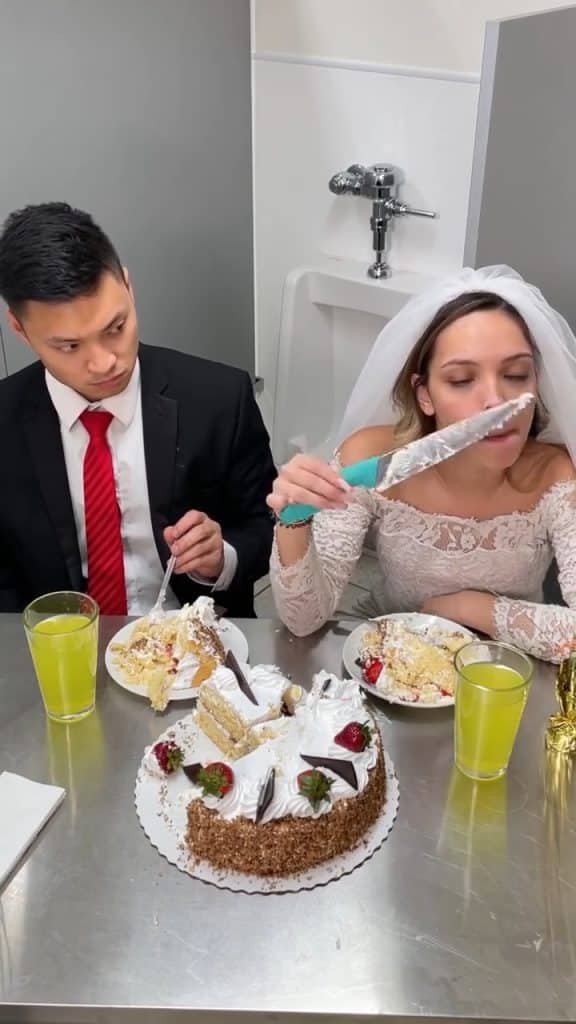
It is the visual hook that stops you dead in your scroll. A pristine white wedding dress. A sharp black tuxedo. A decadent, multi-layered cake. And behind them… a row of public urinals?
In the bizarre world of viral social media skits, logic often takes a backseat to spectacle, but a recent video circulating on TikTok and Facebook Reels has taken absurdity to a new level. The video features a bride and groom enjoying what appears to be their wedding cake, seated at a metal table in the middle of a men’s public restroom. But the setting is the least of the viewer’s worries.
What unfolds in the span of sixty seconds is a masterclass in silent tension, confusing imagery, and a climax that leaves millions of viewers asking the same questions: What is in that syringe? Why are they in a bathroom? And what did the groom do to deserve this?
In this deep-dive analysis, we are going to break down this viral phenomenon frame-by-frame, explore the psychology behind “oddly satisfying” yet disturbing content, and try to unravel the mystery of the syringe-wielding bride.
1. The Setup: A Wedding in the Water Closet?
The video begins with an immediate assault on the viewer’s sense of normalcy. Usually, wedding content implies beauty, romance, aesthetic venues, and soft lighting. This video flips the script entirely.
The Setting: The first thing you notice is the cognitive dissonance of the background. We see a bride and groom seated at a stainless steel table. But they aren’t in a banquet hall; they are in a tiled public restroom. Specifically, the presence of a urinal directly behind the groom confirms this is a men’s room.
Why this setting? In the economy of attention, “weird” wins. By placing high-status characters (a bride and groom) in a low-status environment (a bathroom), the creators create an immediate “pattern interrupt.” You cannot scroll past because your brain is trying to reconcile the conflicting images. Are they hiding? Is this a shotgun wedding gone wrong? Or is this just the only place they could find privacy?
The Characters:
- The Groom: Dressed in a classic black suit with a striking red tie. He appears calm, perhaps even oblivious. He is the “mark”—the unsuspecting victim of the scene.
- The Bride: Dressed in an off-the-shoulder lace gown with a veil. She looks the part of a princess, but her body language screams “villain.” She is hyper-alert, shifting her eyes, and clearly plotting something sinister.
2. The Plot Thickeners: Frame-by-Frame Breakdown
Let’s dissect the narrative arc. This isn’t just a random clip; it follows a strict three-act structure condensed into a micro-format.
Act I: The Deception (0:00 – 0:05)
The scene opens with the couple eating slices of a large vanilla cake with strawberry filling. There are two glasses of a neon-yellow beverage (likely lemon soda or energy drink) on the table.
The tension spikes immediately. The groom turns his head to the left, looking off-camera. It’s a classic misdirection trope. Is he looking at someone entering the bathroom? Or is he just distracted? It doesn’t matter, because the bride seizes her window of opportunity.
From the folds of her dress or under the table, she produces a medical-grade syringe. It is filled with a dark, opaque brown liquid.
This is the “Hook.” The audience is now complicit in the crime. We know something the groom doesn’t.
- Is it soy sauce?
- Is it concentrated coffee?
- Is it hot sauce?
- Is it… something worse?
With surgical precision, she injects the mystery brown fluid deep into the sponge of the groom’s cake slice. She withdraws the needle quickly, hiding the evidence just as the groom turns back around.
Act II: The “Poison” Test (0:06 – 0:15)
This segment is pure Hitchcockian suspense. The groom returns to his meal. He picks up his fork. He cuts into the exact spot where the liquid was injected.
As a viewer, you are holding your breath. Will he taste it? Will he spit it out? Will he pass out?
The bride’s acting here is crucial. She takes small bites of her own cake, but her eyes never leave him. She looks nervous, perhaps even a little guilty, or maybe excited. This is the “Social Feedback Loop.” We aren’t just watching the action; we are watching her reaction to the action.
The groom eats the cake. He chews. He swallows. Nothing happens.
He doesn’t gag. He doesn’t grab his throat. He just reaches for his yellow drink to wash it down. This deepens the mystery. If the liquid was something vile like soy sauce or vinegar, he would have reacted immediately. The fact that he didn’t suggests the liquid might be tasteless (a sedative?) or sweet (cola?), or perhaps the groom has a terrible sense of taste.
Act III: The Aggressive Climax (0:16 – End)
Just as the tension seems to diffuse, the video takes a violent turn. The groom is drinking his soda, seemingly safe. Suddenly, without provocation, the bride grabs a fresh, massive slice of cake from the center platter.
With one fluid motion, she smashes the cake directly into the groom’s face.
It’s not a playful “wedding tradition” smash. It’s aggressive. It’s messy. It covers his eyes, nose, and pristine suit. The video cuts to black precisely at the moment of impact.
3. The Psychology of the “Cliffhanger”
The video ends with a Spanish overlay text: “Comenta Next para continuar viendo” (Comment Next to continue watching).
This is the engine that drives modern content monetization. The creators have deliberately left the narrative unresolved. This technique relies on the Zeigarnik Effect—a psychological phenomenon which states that people remember uncompleted or interrupted tasks better than completed ones.
Because the story didn’t resolve (We never found out what was in the syringe, or why she smashed the cake), our brains are itching for closure.
The Unanswered Questions generate the comments:
- The Syringe Mystery: The brown liquid is the biggest MacGuffin. In the comments section of similar videos, users debate endlessly. “It looked like balsamic vinegar!” “No, it was laxatives!” “Maybe it was chocolate sauce?” This debate drives the algorithm.
- The Motive: Why does she hate him? Is this revenge for cheating? Is she trying to knock him out so she can run away? Or is this just a fetish content piece?
- The Location: The bathroom setting remains the elephant in the room. It implies secrecy and shame, adding a layer of grit to the wedding attire.
4. Visual Contrast and Color Theory
From a production standpoint, the video is engineered to pop on a smartphone screen. The color grading is high-contrast.
- White (Purity vs. Mess): The abundance of white—the dress, the frosting, the tiles—creates a canvas. We know instinctively that “white” gets dirty easily. This creates subconscious anxiety. We are waiting for the mess. When the brown liquid appears, it stands out starkly against the white cake.
- Red (Danger): The groom’s tie is a bright, solid red. In visual storytelling, red often signals danger or a target. He is marked from the beginning.
- Yellow (Artificiality): The neon yellow drinks look chemical and artificial, adding to the slightly “off” or sickly vibe of the bathroom setting.
5. Why Do We Watch “Cringe” Content?
This video falls squarely into the category of “Skits” or “Scripted Dramas” that masquerade as reality. Most savvy internet users know this is staged. The camera angles are too perfect, the lighting is too bright for a public restroom, and the syringe was too convenient.
So, why do we watch?
1. The “Train Wreck” Fascination Humans have a morbid curiosity. We like to watch social norms being violated. Eating in a bathroom violates a hygiene norm. Injecting unknown fluids into food violates a trust norm. Smashing cake into a spouse’s face violates a relationship norm. We watch to see the consequences of broken rules.
2. The ASMR Factor Believe it or not, there are elements of ASMR (Autonomous Sensory Meridian Response) here. The sound of the fork on the plate, the visual texture of the soft cake, the liquid being depressed from the syringe. For some, these are satisfying sensory inputs, even if the context is gross.
3. The “Guessing Game” We love to be detectives. Viewers watch these videos to spot the flaws. “Look at the mirror, you can see the cameraman!” or “He clearly saw her do it!” By critiquing the video, the viewer feels superior to the content, which feels good. The creators know this; they often leave mistakes in on purpose to encourage “correction comments.”
6. The Economics of the Skit: Why This Format is Gold for Creators
For content creators, this specific format—the “Silent Drama”—is a goldmine for AdSense and RPM (Revenue Per Mille) optimization.
- Language Barrier Free: There is no dialogue. The story is told entirely through action. This means the video can go viral in the US, Brazil, Vietnam, Russia, and Japan simultaneously. The audience is global, which maximizes the view count.
- High Retention: The suspense of the syringe keeps people watching until the end. Retention is the #1 metric platforms care about.
- Loopability: Because the video ends so abruptly, many users let it loop to see if they missed a detail. Did he flinch? Did she smile?
- Interaction Bait: The explicit call to action (“Comment Next”) forces the engagement metrics up, signaling to the algorithm that this content is valuable.
AdSense Optimization Note: For bloggers covering this trend, keywords are crucial. Terms like “Viral Wedding Fail,” “Bride Prank Groom,” “Strange Internet Trends,” and “Relationship Drama” attract high-cost-per-click (CPC) ads. Advertisers in the relationship counseling, wedding planning, and even mobile gaming sectors often bid on this type of traffic.
7. Analyzing the “Brown Liquid”: Theories from the Internet
Let’s go back to the central mystery. What was in the syringe? Based on the viscosity and color seen in the clip, here are the top theories:
- Theory A: Concentrated Espresso. This would explain why the groom didn’t gag. If he loves coffee, a bit of espresso in a vanilla cake might actually taste like tiramisu.
- Theory B: Soy Sauce or Worcestershire Sauce. This is the “prank” angle. However, the saltiness would be overwhelming. The groom’s lack of reaction suggests he is either a terrible actor or the liquid wasn’t that bad.
- Theory C: Cola or Root Beer. A syrupy soda would blend into the sweetness of the cake, making it undetectable.
- Theory D: “Prank Prop” Liquid. In many of these skits, the creators use colored water or tea because it’s easy to clean up and doesn’t stain the expensive rental tuxedo as badly as real soy sauce would.
8. Conclusion: The Never-Ending Soap Opera
The video of the Bride, the Groom, and the Syringe in the Bathroom is not high art. It isn’t a documentary. It is digital junk food—quick, colorful, and leaving you wanting more.
It represents a fascinating shift in how we consume stories. We no longer need 90-minute movies; we are satisfied with 60-second micro-dramas that ask absurd questions and refuse to answer them.
Will there be a “Next” part? Probably. Will it explain why they are eating in a bathroom? Probably not. Will the groom ever get the cake off his face? Only until the next take.
But as long as creators keep injecting mystery fluids into pastries in public restrooms, the internet—and its advertisers—will keep watching.
What do you think was in the syringe? Was it a harmless prank or a malicious act? And have you ever seen a wedding reception in a worse location? Leave your theories in the comments below!