The afternoon sun beat down on the suburban driveway as the delivery driver unloaded the final cardboard box onto the hand truck. He wiped his brow, completely unaware that his simple delivery was about to trigger a high-tech game of cat and mouse. Up above, the lens of “CAM 03,” a high-definition smart home security camera, glowed with a faint red ring. It tracked his movement, instantly sending a push notification across town.
Miles away, in a bustling coffee shop, Eleanor Carmichael felt her phone buzz. She was a woman who took home security seriously—perhaps a bit too seriously. Wrapped in a pink turtleneck and her favorite fuzzy winter hat, she tapped the notification. The screen displayed the delivery man on her porch. But Eleanor’s hyper-vigilant mind immediately jumped to her next concern: her teenage son, Leo. He was supposed to be strictly grounded, confined to his bedroom to finish a massive history term paper.
Eleanor opened her home surveillance app and dialed Leo’s number on a video call.
Across town, nowhere near his bedroom desk, the reality was vastly different. Leo was lounging in a friend’s basement, surrounded by empty pizza boxes and glowing monitors. The basement belonged to Chloe, a brilliant computer science major who spent more time tweaking neural networks than attending lectures. When Leo’s phone lit up with “Mom – Incoming FaceTime,” panic erupted.
“What the—” Chloe gasped, her eyes widening behind her thick-rimmed glasses as she stared at her command console. She adjusted her gaming headset, her fingers hovering over her mechanical keyboard. “She’s requesting a live video feed, Leo. The proxy server is barely holding the connection.”
Jake, another friend leaning against the wall in a brown collared shirt, shook his head in disbelief. “She’s so on to you, man. You’re dead. She knows you’re not in your room.”
Leo, however, possessed the infuriating calm of a teenager who believed he was invincible. He ruffled his curly blonde hair, accepted the audio portion of the call, and let out an exaggerated, theatrical yawn.
“Hey, Mom,” Leo mumbled, grabbing a bright orange plastic cup and taking a slow sip. “Just grinding through the Industrial Revolution. What’s up?”
Eleanor wasn’t buying it. The background noise sounded a little too hollow, and maternal instinct is a powerful lie detector. She narrowed her eyes at her smartphone screen, adjusting the sunglasses resting on her fuzzy hat. She decided to deploy a tactic she had read about in a cybersecurity blog to defeat pre-recorded video loops.
“Turn your camera on, Leo,” Eleanor commanded. “And if you’re really at your desk, hold up your left arm and raise two fingers.”
In the basement, Jake’s jaw dropped. Chloe’s fingers immediately slammed onto her keyboard, flying across the keys in a frantic blur of keystrokes.
“I need ten seconds!” Chloe hissed. She was running a state-of-the-art, real-time deepfake rendering software. It mapped Leo’s voice and facial micro-expressions onto a pre-recorded, 3D-scanned environment of his actual bedroom.
Leo smirked, entirely unbothered. “Alright, alright, chill out,” he said into the phone.
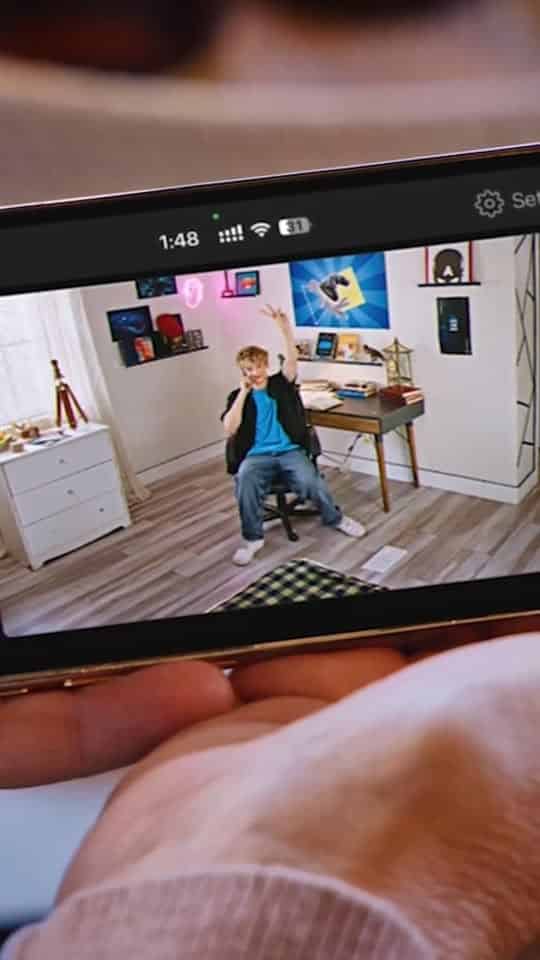
On Eleanor’s screen, the video feed flickered to life. There was Leo, sitting exactly where he was supposed to be: at the wooden desk in his room, posters perfectly aligned on the wall behind him. Eleanor watched like a hawk.
In the basement, Chloe hit the EXECUTE key.
On the phone screen, the digital avatar of Leo flawlessly raised its left arm and extended exactly two fingers. The physics of the digital clothing folded perfectly. The lighting matched the afternoon sun filtering through his bedroom window. To add a touch of teenage rebellion, Chloe programmed the avatar to kick off the desk and spin casually in the computer chair.
Eleanor stared at the screen, her lips parted in slight confusion. It looked incredibly real. There were no pixel tears, no audio lag, no uncanny valley glitches.
“Or do you want me to dance too?” Leo’s sarcastic voice echoed through her phone speaker, perfectly synced to the digital lips on the screen. “Happy?”
“Fine,” Eleanor muttered, feeling a strange mix of relief and lingering suspicion. “Finish your essay. I’ll be home in an hour.”
She hung up, entirely unaware that she had just been outsmarted by a mix of artificial intelligence and teenage audacity.
Back in the basement, the room erupted into cheers. Jake tackled Leo, and Chloe collapsed back into her gaming chair, letting out a massive breath. They had done it. They had successfully bypassed a modern smart-home surveillance grid using real-time generative AI.
But the victory was short-lived.
An hour later, Eleanor pulled into her driveway. As she walked past the delivery boxes on the porch, a thought gnawed at the back of her mind. When Leo had spun in his chair on the video call, the reflection in his bedroom window hadn’t shifted quite right. It was a minuscule detail—an error in the AI’s ray-tracing algorithm—but for a meticulous mother, it was a glaring red flag.
She marched into the house, bypassing the kitchen, and walked straight up the stairs to Leo’s room. She threw the door open.
The room was perfectly clean. The desk was empty. The computer monitor was cold to the touch. The only thing sitting on the chair was a small, motorized rig holding a smartphone, plugged into a power bank, acting as the proxy server Chloe had used to bounce the signal.
Eleanor picked up the rigged phone, a slow, impressed, yet furious smile creeping onto her face. Her son wasn’t just a truant; he was a digital mastermind. She pulled out her own phone and sent a single text message to Leo:
“The lighting on the window reflection was off by about 15 degrees. See you at home. You’re grounded until college.”
Down in the basement across town, Leo’s phone buzzed. He looked at the screen, the color draining from his face. Chloe leaned over his shoulder, reading the text.
“Well,” Chloe said, adjusting her glasses. “Next time, we calculate for ambient sunlight refraction.”
Technology had evolved, AI had become indistinguishable from reality, and digital privacy was a battleground. But in the end, nothing could truly outsmart a mother’s intuition.